Yes, we add batteries to Enphase and SolarEdge systems.
Your panels stay on the roof. So do your micros or your optimizers, and so does the box they feed on the wall. The storage goes in beside them, AC coupled, and where your model and your design check out, your array goes on producing into the house and the battery while the street is dark. In the Florida panhandle that runs about $16,000 for 16 kWh up to about $27,000 for 48 kWh, installed, as of October 2026. It does not matter who put the panels up.
Nothing comes off the roof.
Enphase and SolarEdge look like different animals up top. Enphase puts a microinverter under every panel, so each panel makes AC right there and the combiner box on the wall brings it together. SolarEdge puts an optimizer under every panel and sends DC down to one inverter on the wall, which makes the AC. Plenty of people get told those are two different upgrade jobs.
They are the same job, because of where the power ends up. Either way, one box on the wall hands your house finished 120/240 volt AC on a single breaker. A battery retrofit has no reason to undo any of that. The only change is where that breaker lands: it moves to a smart port on an EG4 GridBOSS, set to AC Couple, and the GridBOSS sits between the utility, the house, and the new battery inverter.
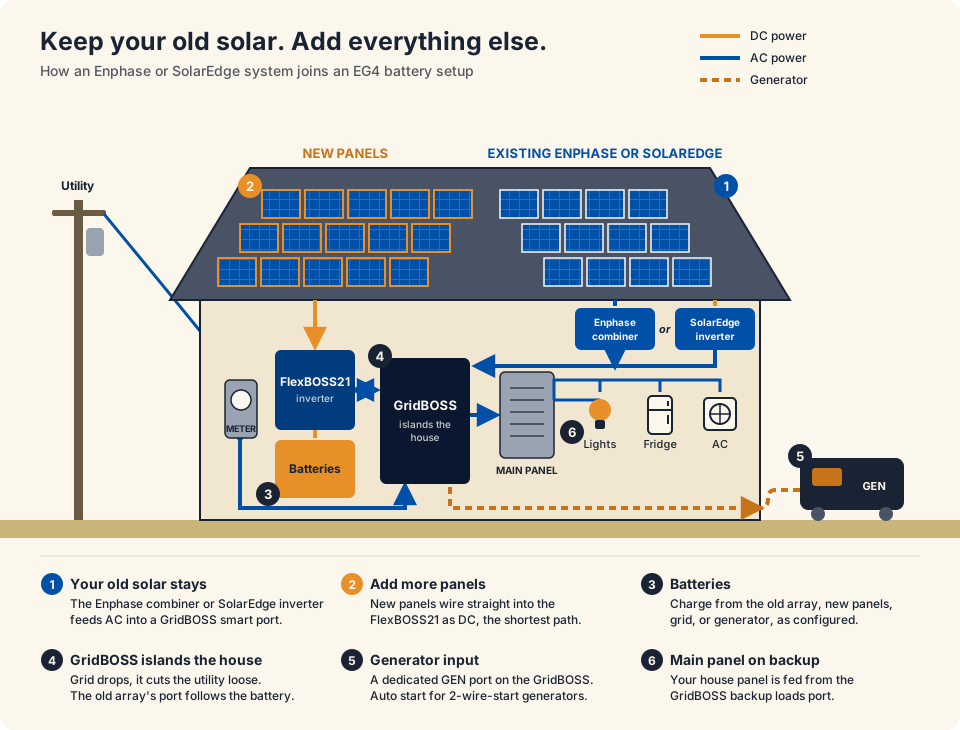
With the grid up, your array can run the house, charge the battery, or go out to the utility, depending on what the house needs that minute and what your interconnection agreement allows. When the grid goes down, the GridBOSS islands the house and the hybrid inverter makes the AC. Where the design checks out, your existing equipment reads that as the grid and goes on producing into the house and the battery, so an outage is not limited to whatever was in the battery when the lights went off. That one is conditional, which is why the checklist further down exists. Your exact model, its firmware, and the grid profile all have a say, and the GridBOSS opens that port when the battery is full or the old array is making more than the system can take.
The Enphase version of this runs on our own shop owner's house in Gulf Breeze: 22 panels on IQ8+ micros in two branches of 11, into an IQ Combiner, landing on a 40 amp breaker in GridBOSS smart port 4, beside the batteries that carry the house. The long version, with the wiring and the one setting that quietly shut the array off every afternoon, is in our post on keeping Enphase or SolarEdge and adding batteries.
We will not quote you an Enphase or SolarEdge battery.
If you came here looking for IQ Batteries or the SolarEdge battery, we do not sell either one. Both cost a good deal more per kilowatt-hour than the EG4 wall mounts we stock, and we took the Enphase IQ Battery 5P off our shelf in September 2026 because hardly anybody chose it once they saw the two prices together. What we quote is EG4 storage AC coupled onto the array you already paid for.
The trade is real and you should hear it from us. You end up with two brands in the house and two apps, one for the panels you have and one for the battery side. Some people want the whole house on one make, one app, and one warranty desk, and that is a fair thing to want. If that is you, a certified installer for your brand is the right phone call, and we will say so on the phone instead of talking you out of it.
One more thing worth knowing, because it surprises people. Enphase's newer IQ8 micros can run a house with the grid down on their own, but only with Enphase's own System Controller at the service entrance. If nobody sold you that box, you do not have it, and your solar shuts off with the grid today. A SolarEdge house has its own version of that question, and the answer is on the inverter nameplate rather than in a brochure, so we read it in the design review. In the retrofit we build, the hybrid inverter makes the island instead, so that controller is not part of the job.
What the retrofit costs here.
Installed price to the customer, Florida panhandle, October 2026. These are bands rather than quotes: your main panel, your meter, and how much of the house you want carried all move the number. Equipment prices change, and the live price of every battery and inverter sits on our shop.
| Setup | Storage | Installed | What you get |
|---|---|---|---|
| EG4 hybrid inverter + GridBOSS + one wall-mount battery | 16 kWh | $16,000 to $20,000 | Whole-home backup with smart load control, room to add battery later |
| Same, with a second battery | 32 kWh | $20,000 to $24,000 | The common pick. A long night, with the central air left out of it |
| Same, with a third battery | 48 kWh | $24,000 to $27,000 | A SolarEdge house sold at $23,465 in October 2026 |
Two real ones off our own books, so the bands have something behind them. A hybrid inverter, a GridBOSS, and three batteries added to an existing 38 panel Enphase system we did not install: $25,400 all in, and a system that used to shut off with the grid now carries that house, which is the scope that job was designed and sized for. A SolarEdge house sold in October 2026: 48 kWh in the garage, all 47 optimizers and the existing inverter left alone, $23,465. On three batteries we will sometimes offer a second hybrid inverter as an add-on, which doubles how fast the bank can take a charge. It is an option on the quote, never built in.
Six things that have to check out.
None of it is exotic. It is a design, interconnection, and permit checklist, run model by model off your actual labels rather than from memory. If an installer quotes you a retrofit without asking about the first three, ask them why.
The model and its listing
Your exact microinverter or inverter model, read off its own label rather than off the combiner, and whether it is listed to UL1741, SA, or SB. That listing is what the GridBOSS requires of an existing inverter.
Firmware and the grid profile
The old inverter and the new one coordinate by frequency, so the profile your system was commissioned on matters as much as the model.
Array output against battery
How much AC your existing side makes at its peak, measured against what the battery can take as charge. A big array on a small battery fails this check, and the fix is sizing rather than hope.
The panel, the meter, and the service
Your main panel rating and condition, the meter, and how the house is fed. A retrofit that also rebuilds the service entrance adds an electrical permit on top.
Your interconnection agreement
The agreement you already have with the utility, usually FPL Northwest Florida here, which normally gets amended when storage goes in.
Who owns the array
A leased or PPA system needs the lease company to sign off before any of the rest of it matters. Owned outright, this one takes ten seconds.
Designed here, installed by a licensed contractor.
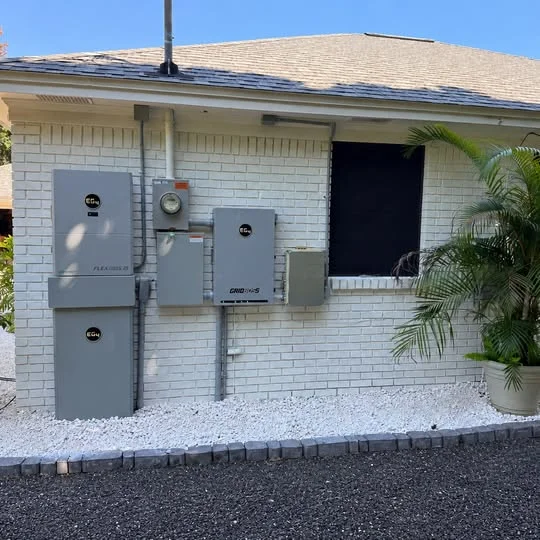
Ape Solar designs the retrofit around the system you have and the loads you want covered, supplies the equipment from our Gulf Breeze warehouse, and runs the project. The install is performed by a state-licensed electrical contractor. Advanced Wire Pros (Florida license EC13005911) is our primary contractor of record, with Webster Electric (EC13005573) and Kent Electric (EC13009116) covering other parts of the panhandle. We are the EPC and project manager, and we do not hold a contractor license ourselves.
We are not certified by Enphase or SolarEdge, and this job does not need it. Nothing inside your micros, optimizers, combiner, or inverter is opened, modified, or re-commissioned, and the work happens at the breaker those boxes feed. What that means for your manufacturer warranty is set by that manufacturer’s own terms and your exact configuration, so read them or call them rather than take our word for it. If you would rather price the parts yourself first, the system builder puts a full setup together at live prices, and the general retrofit page covers systems that are neither brand.
Questions we actually get.
Can you add batteries to an existing Enphase or SolarEdge system?
Yes. Ape Solar adds battery backup to existing Enphase and SolarEdge systems in Pensacola, Gulf Breeze, Navarre, Milton, Pace, and the rest of the Florida panhandle, including systems installed by companies that are no longer in business. Nothing comes off the roof. The array is AC coupled, which means your panels and the equipment that goes with them stay exactly where they are and the battery side goes in beside them. It is the retrofit we do most, and we sold two of them in the week of October 13, 2026, one Enphase and one SolarEdge.
Do my microinverters or optimizers have to come off the roof?
No, and neither do the panels. On an Enphase roof the micros stay under the panels and the IQ Combiner stays on the wall. On a SolarEdge house the optimizers stay under the panels and the inverter stays on the wall. The one change is where that box lands: its breaker moves from your main panel to a smart port on an EG4 GridBOSS set to AC Couple. One recent SolarEdge retrofit kept all 47 optimizers and the existing inverter.
Why is the job the same for Enphase and SolarEdge?
Because of where the power ends up. Enphase makes AC up at each panel and brings it together in the combiner box. SolarEdge sends DC down from the optimizers to one inverter on the wall, which makes the AC there. Either way, one box hands your house finished 120/240 volt AC on a single breaker, and that breaker is what moves to the GridBOSS. People get told these are two different upgrades. They are the same upgrade with a different box on the wall.
Do you install Enphase IQ Batteries or the SolarEdge battery?
No, and we will say why rather than dance around it. Both brands charge a good deal more per kilowatt-hour than the EG4 wall mounts we stock, and we took the Enphase IQ Battery 5P off our shelf in September 2026 because hardly anybody picked it once they saw the two prices together. What we quote is EG4 storage AC coupled onto the array you already paid for. If keeping the whole house on one make matters more to you than the price gap, that is a fair thing to want, and a certified installer for your brand is the right phone call.
What does it cost to add batteries to an Enphase or SolarEdge system in Pensacola?
As of October 2026, installed, in the Florida panhandle: about $16,000 to $20,000 for 16 kWh of EG4 storage, about $20,000 to $24,000 for 32 kWh, and about $24,000 to $27,000 for 48 kWh. Each of those includes the hybrid inverter and the GridBOSS that make the AC coupling work, so the step from one battery to three is mostly battery. One 48 kWh retrofit sold in October 2026 landed at $23,465. Your main panel, your meter, and how much of the house you want carried all move the number, and equipment prices change, so read the live price of any battery or inverter on our shop.
Will my existing array keep producing during a power outage?
That is the point of doing it this way, and it is worth asking any installer directly. When the utility drops, the GridBOSS cuts your house loose from the grid and the EG4 hybrid inverter makes the AC for the house. Your existing micros or inverter see that power, take it for the grid, and keep producing into the house and the battery while the street stays dark. How much you actually get back each day comes down to sun, weather, and what you are running. Whether your exact model will follow an islanded source is a nameplate and firmware check we run in the design review rather than something to assume, and the array also gets sized against the battery, because the GridBOSS opens that port when the battery is full and the house is quiet.
Will the battery back up my whole house, or just some circuits?
That is a sizing decision and a panel decision rather than a limit of the retrofit. Critical loads means refrigeration, lights, internet, fans, and a well pump if you have one, and it is the affordable way in. Whole-home adds central air, which is the biggest load in a Florida house and roughly doubles the battery you need. Plenty of people back up everything except the AC on purpose, and we will show you both numbers before you pick.
How long does the retrofit take?
The work on site is usually short, often a day or two, and the calendar is longer than the work. The permit and the utility paperwork take their own time, and a retrofit that also rebuilds the main service panel adds an electrical permit on top of that. We will give you the real sequence for your address rather than a brochure timeline.
Does this work with older equipment, or only the current models?
The decision is made off the nameplate rather than the generation name. What the GridBOSS needs is an existing inverter listed to UL1741, or its SA or SB versions, and we read the exact model and its listing off the label in the design review. The IQ8+ micros on our own shop owner’s roof are listed to UL1741 SB. One thing that trips people up on the Enphase side: the label on your IQ Combiner is not your microinverter model. We have had a survey come back with the combiner part number written down as the micro, which answers nothing. On a SolarEdge house it is simpler, because the model you need is on the inverter nameplate on the wall.
Are you an Enphase or SolarEdge certified installer?
No, and here is what that does and does not mean for you. We are not certified by either manufacturer and we do not hold a contractor license ourselves. Nobody re-commissions your existing system in this job, nothing inside the micros, the optimizers, the combiner, or the inverter is opened or modified, and the work happens at the breaker those boxes feed. Ape Solar designs the retrofit, supplies the equipment from our Gulf Breeze warehouse, and runs the project. A state-licensed electrical contractor does the physical install and pulls the permit. If your real question is what this does to your existing warranty, that is set by the manufacturer’s own terms and your exact configuration. We will tell you exactly what we are touching and what we are not, and you should read those terms or call them rather than take our word for it.
Who does the electrical work and pulls the permit?
A state-licensed electrical contractor. Advanced Wire Pros (Florida license EC13005911) is our primary contractor of record, with Webster Electric (EC13005573) and Kent Electric (EC13009116) covering other parts of the panhandle. They make the connection at your service and pull the permit. Ape Solar is the EPC, which means we engineer the system, procure the equipment, and run the construction, and we do not hold a contractor license.
Does FPL have to approve anything?
Usually yes. Your existing solar runs under an interconnection agreement with the utility, FPL Northwest Florida in most of Escambia and Santa Rosa counties, and adding storage normally means amending it. Whether your old array is allowed to export while the grid is up is set by that agreement rather than by the equipment, and the GridBOSS will hold its port open rather than export against it. We handle the paperwork as part of the job and we will tell you the real sequence for your address instead of a brochure timeline.
What do you need from me to quote it?
Two photos and one answer. Photograph the label on your Enphase combiner or microinverter (the system details screen in the Enphase app works too) or the nameplate on your SolarEdge inverter, photograph your main electrical panel with the door open, and tell us roughly what you want running when the power is out. That is usually enough to put a real number in front of you before anyone drives out. If your system is leased or on a PPA, say so up front, because the lease company has to sign off before anything else happens.
Send us a nameplate and a panel photo.
A photo of your Enphase combiner or micro label, or your SolarEdge inverter nameplate, plus your main panel with the door open. That is enough for us to put a real number in front of you before anyone drives out.