Ask anyone with a roof full of panels where their power went during the last storm. A lot of them will tell you the same thing: the grid dropped, and the solar dropped right with it. They paid for panels, they watched the neighbors' houses go dark, and then they found out theirs was dark too.
Since the storm we've been taking calls from people with solar and no battery who found this out in the dark. Not one of them knew. A grid-tie system with nothing at the service entrance to island the house shuts itself off the moment the utility goes down. That's a safety rule, and a good one: it keeps a solar array from pushing power onto a line a lineman thinks is dead. It's also the first thing you learn about grid-tie inverters, so the company that sold the system knew. It didn't make the pitch, because the pitch was about the bill. (Enphase's newer IQ8 micros can run with the grid down, but only with Enphase's IQ System Controller at the service entrance. If nobody sold you that box, you don't have it.)
Now those same homeowners call us wanting batteries, and the next surprise is the quote that starts with "first we tear out your existing system." You don't have to. Both of these systems plug into an EG4 battery setup the same way, and the panels on your roof never find out anything changed.
Why the brand doesn't matter here
Enphase and SolarEdge look different on the roof. Enphase puts a little microinverter under every panel, so each panel makes AC right there. SolarEdge puts an optimizer under every panel and sends DC down to one inverter on the wall, which makes the AC. People get told those are two totally different upgrade jobs.
They aren't, because of where the power ends up. Both systems hand your house finished AC power, the same 120/240 volt power the rest of the house runs on. On an Enphase roof it comes together in the combiner box on the wall. On a SolarEdge house it comes out of the wall inverter. Either way, one box on the wall carries the whole array's output on one breaker.
That breaker is where the licensed contractor lands the connection.
Where it plugs in
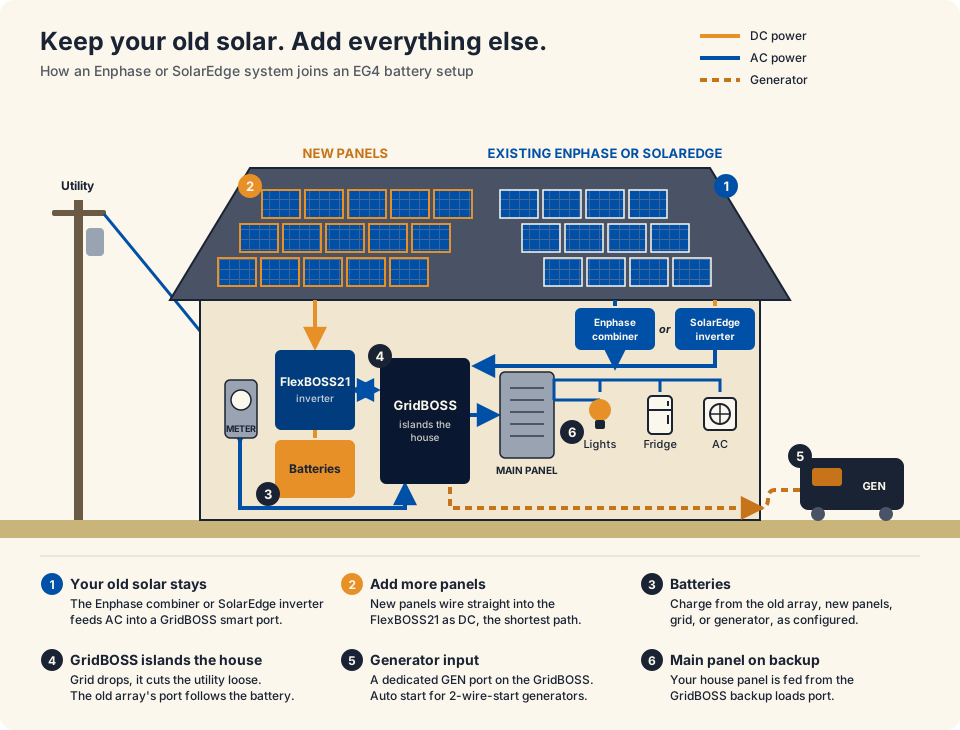
Our battery systems are built around two EG4 boxes. The FlexBOSS21 is the hybrid inverter that runs the batteries and any new panels. The GridBOSS sits between the utility, the inverter, and your house panel, and decides where power goes.
The GridBOSS has four smart ports. Each one is a breaker plus a relay you control from the app. A smart port can run a load you want to switch, like a water heater or an EV charger, or it can be set to AC Couple, which turns it into an input. Your Enphase combiner or SolarEdge inverter lands on that port. Any of the four can be set to AC Couple; which one depends on the breaker the old system needs, since port 1 takes up to 125A, port 2 up to 80A, and ports 3 and 4 up to 60A.
With the grid up, the old array's power can feed the house, charge the batteries, or go out to the grid, all through the GridBOSS, depending on what the house needs at the moment. The GridBOSS only closes that port while the FlexBOSS is set to export (and inside the port's time window), and exporting at all rides on your interconnection agreement with the utility. If you can't export, the GridBOSS opens the port while the grid is up and the old array sits idle, so the agreement gets sorted in the design. Adding batteries usually means amending the one you have.
Then the grid goes down. The GridBOSS cuts the house loose from the utility, an island of its own, and the FlexBOSS21 makes the AC. Your old Enphase or SolarEdge system sees that power, takes it for the grid, and keeps producing into the house and the batteries while the street sits in the dark. That's how Josh's house ran through the last storm. The GridBOSS stays in charge of the port the whole time. Off grid it closes and opens the port on the battery level and the time window, and it opens the port if the old array is making more than the inverter and battery can take. So when the battery is full and the house is quiet, the old array rests until the battery wants charge again. That's the manual's rule, and it's why the old array gets sized against the battery in the design.
It runs on Josh's own roof
Josh, who runs the shop, has this setup at his house. He already had a FlexBOSS21 and a GridBOSS running 26 panels wired the normal way. Then he added 22 more Canadian Solar 395W panels on Enphase IQ8+ micros, two branches of 11, into an Enphase IQ Combiner. That's 8.69kW of panels making 6.6kVA of AC, and it lands on a 40A breaker in GridBOSS smart port 4, set to AC Couple.
The sizing check on his house: the micros make 6.6kVA at their peak, and his 14.3kWh battery can take about 7.2kW of charge, so on paper the battery can take the whole Enphase side even with nothing running in the house. The full check also counts the 26 DC panels on the FlexBOSS and what the house is actually drawing, which is why it gets run on every design, and why a bigger array on a smaller battery can fail it.
On a September afternoon we watched about 5.5kW coming in through that port.
It also handed us the gotcha worth knowing about. For a while the Enphase side went dark every afternoon. The panels were fine and the micros were fine. Each AC Couple port has a time window, a start time and an end time, and the GridBOSS only closes the port inside that window. His ended at 12:59 PM, so every afternoon the relay opened and the best sun of the day went nowhere. The fix took one setting. The port also has a start and end battery level, which works with the time window to run it during an outage. If your old array seems to quit at the same time every day, or whenever the battery fills, those three settings are the first place to look.
The honest tradeoff
When the old array's power goes into a battery, it gets converted from AC back to DC on the way in, then to AC again when you use it later. A new array wired straight into the FlexBOSS skips that first step. On the FlexBOSS21 spec sheet, panel-to-battery runs up to 94.5 percent and AC-to-battery up to 94 percent, so the hop into the battery costs about the same either way. The difference is whatever your old inverter gives up making the AC in the first place, and that depends on the model. Power the house uses as it's made, like the AC running on a July afternoon, skips the battery entirely.
That loss is real, and in our opinion it's a bad reason to throw out equipment that still works. If your micros or your SolarEdge inverter are near the end of their warranty and you were going to replace them anyway, that's the time to talk about a fresh DC build. Otherwise keep what you paid for.
What the job looks like
This is the wall at Josh's house.
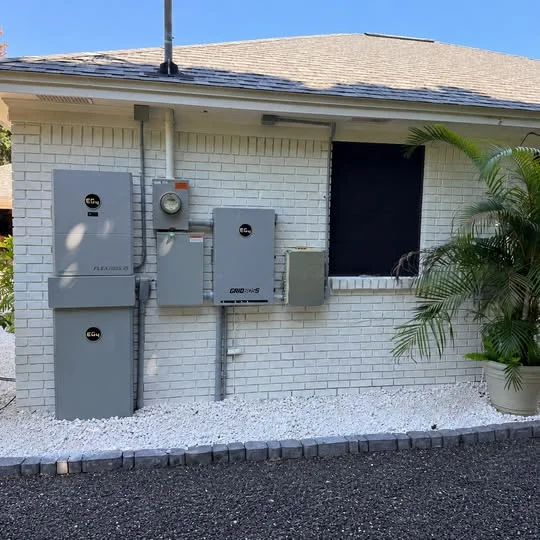
The FlexBOSS21 sits on the left with the battery right under it. The meter is next in line, then the GridBOSS, and the small grey box on the far right is the Enphase IQ Combiner, where the two branches of micros come together. From there the array's AC runs to smart port 4 on that 40A breaker. On a SolarEdge house, the SolarEdge inverter sits in the combiner's spot: it turns the roof's DC into AC and lands its breaker on the GridBOSS, same as the combiner.
The GridBOSS also has a generator input, and the FlexBOSS21 has room for new panels wired straight in, so the upgrade can grow past the batteries.
What has to check out first
The GridBOSS requires the old inverter to be listed to UL1741 (or the SA or SB versions of it), the grid-tie standard. The IQ8+ micros on Josh's roof are listed to UL1741 SB; whatever is on yours, we read the exact model's listing off the nameplate in the design review. The review goes past the label: your exact inverter model and its firmware, the grid profile it was commissioned on (the old inverter and the FlexBOSS coordinate by frequency, so that profile matters), how old and healthy the old gear is, the old array's output against your battery, what you want to stay on when the grid drops, your meter and service, who owns the array (a leased system needs the lease company's sign-off before anything else), your interconnection agreement, and the FlexBOSS21 itself on firmware new enough for the GridBOSS (the manual sets a minimum). None of it is exotic. It's a design, interconnection, and permit checklist, run model by model. A state-licensed electrical contractor does the physical install and pulls the permit. We design the system and run the job. The longer version is in our guide on adding batteries to existing solar.
Two photos get it started: the label on your Enphase combiner or SolarEdge inverter, and your main electrical panel with the door open. Send them through apesolar.com/build or text the shop, and we'll tell you straight whether your system is a good fit, even if the answer is to leave it alone.
Ready for Anything.