EG4's lineup splits into two families, plus one box people keep calling an inverter even though it makes no power. The XP units (6000XP and 12000XP) are off-grid style. They run your loads from sun and battery, and they cannot sell power back to the utility. The hybrid family (18kPV, FlexBOSS18, FlexBOSS21) does everything the XPs do and can also work with the grid, net metering included. The sixth box, the GridBOSS, is the 200A microgrid interconnection device that manages the grid tie and the whole-home transfer for up to 3 EG4 hybrids.
That is the whole map. The rest walks each unit with numbers verified against the spec sheets in our own catalog.
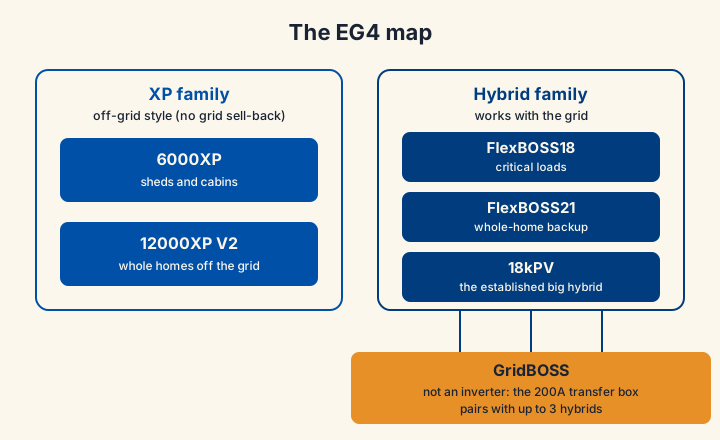
The lineup at a glance
| Unit | Continuous output | Max usable PV | MPPTs | Listing | Anchors |
|---|---|---|---|---|---|
| 6000XP | 6,000W | 8,000W (4,000W per MPPT) | 2 (17A each) | UL1741 | Shed & Cabin kit |
| 12000XP V2 | 15,000W with PV, 12,000W battery-only | 24,000W | 2 | UL1741 | Off-Grid kit |
| 18kPV | 12,000W at 240V (10,400W at 208V) | 18,000W | 3 | UL1741/SA/SB | Sold on its own |
| FlexBOSS18 | 13,000W with PV, 10,000W battery-only | 18,000W | 2 | UL1741 | Critical Load Backup kit |
| FlexBOSS21 | 16,000W with PV and battery, 12,000W battery-only | 21,000W | 3 (26A, 26A, 15A) | UL1741/SA/SB | Whole-Home Backup kit |
| GridBOSS | Makes no power. 200A interconnect device. | n/a | n/a | UL1741/67/869A | Rides with the FlexBOSS builds |
One note on the MPPT column. An MPPT is an independent solar input that runs its own strings of panels at their own sweet spot, so two roof faces pointed different directions want two MPPTs. More MPPTs, more freedom in the array layout.
Two families and a traffic cop
The XP family is the simple one. Sun in, battery in the middle, power out to your loads. No sell-back, no utility paperwork for exports, no interconnection agreement. That makes an XP the natural pick for a cabin, a well house, a homestead past the last pole, or anyone who wants the utility out of the conversation entirely.
The hybrid family keeps all of that and adds a working relationship with the grid. A hybrid can carry the house during an outage, then push surplus solar to the utility on a sunny afternoon and earn the net metering credit. If the plan involves the meter running backward, you are shopping in this family.
The GridBOSS is neither. It has no MPPT and it makes no AC power. It sits at the 200A service, between the meter and everything else, and directs traffic: grid, hybrid inverters, generator, and four smart load ports, all through one box. When the grid drops, it handles the whole-home transfer. It supports up to 3 EG4 hybrids, so a system built around it has room to grow.
EG4 6000XP
The starter, and honestly the one we hand across the counter most often. The 6000XP is a 48V off-grid inverter that puts out 6,000W continuous and takes up to 8,000W of solar, split 4,000W across each of its two MPPTs at 17A apiece. It surges to 12,000W for 3.5 seconds, which is what gets a well pump or a compressor spinning.
Who it is for: a shed, a small cabin, a workshop, a first system. It anchors our Shed & Cabin kit with one battery and a small string of panels. And if you outgrow it, the 6000XP parallels up to 16 units, though at that point the next unit down this page is usually the smarter buy.
EG4 12000XP V2
The same off-grid idea, sized for a whole house. The 12000XP V2 delivers 15,000W of continuous output when the sun is up and helping, and 12,000W running on battery alone. That with-PV number matters: live solar lets it carry more load than the battery path can alone, so a hot afternoon with the AC running is when it has the most muscle. It surges to 15,360W for 10 seconds.
The headline spec is the solar input. This unit takes up to 24,000W of PV across two MPPTs, triple what the 6000XP accepts, which means a big array can float a big battery bank through the cloudy stretch. It is a 48V unit, parallels up to 16, and carries the UL1741 listing. It anchors our Off-Grid kit, the standard full-time off-grid build we quote. Like every XP, it does not sell power back.
EG4 18kPV
The established hybrid. The 18kPV puts out 12,000W at 240V (10,400W at 208V), takes up to 18,000W of PV, and spreads it across three MPPTs. It carries the UL1741/SA/SB listing, and it is one of the hybrids the GridBOSS accepts on its ports.
Who it is for: someone who wants a grid-interactive system on a proven platform. Our packaged kits have moved to the FlexBOSS units below, so the 18kPV sells on its own through the shop rather than anchoring a kit.
EG4 FlexBOSS18
The middle hybrid, and the workhorse of our grid-tied builds. The FlexBOSS18 puts out 13,000W continuous with PV and 10,000W on battery alone, takes up to 18,000W of solar on two MPPTs, and is listed to UL1741.
Who it is for: the family that wants the fridge, the lights, the internet, and the bedroom window unit to stay on through an outage without paying for whole-home capacity. It anchors our Critical Load Backup kit, and it is also the inverter behind our 8kW net metering build, where it pairs with a GridBOSS and skips the battery until you want one.
EG4 FlexBOSS21
The big hybrid. The FlexBOSS21 puts out 16,000W continuous with PV and battery together, 12,000W on battery alone, and accepts up to 21,000W of solar across three MPPTs rated 26A, 26A, and 15A. It carries the UL1741/SA/SB listing.
Who it is for: whole-home backup, large all-electric houses, pool pumps, EV chargers, the works. It anchors our Whole-Home Backup kit, where it pairs with a GridBOSS at the service and a wallmount battery bank in the garage. When a customer says "I want the house to just keep running," this is the box we reach for.
EG4 GridBOSS
The GridBOSS is not an inverter. EG4 calls it a MID, a microgrid interconnection device, and its whole job is managing the point where your system meets the utility. It is rated for a 200A service, offers 4 smart load ports for shedding or adding loads on a schedule, connects up to 3 EG4 hybrids, and carries the UL1741/67/869A listing.
In practice it replaces a pile of separate transfer and interconnection hardware with one enclosure. It rides along in our whole-home and net metering builds next to a FlexBOSS, and it is the reason those systems are battery-ready: the transfer gear is already in place, so batteries bolt on later with nothing else to change.
What it means for your build
Match the family to your relationship with the grid first, then match the numbers to your loads. Off the grid for good, or just done with the utility? XP family, sized by your battery-alone number, because that is what carries the house at 2am. Want the meter spinning backward? Hybrid family, and plan on a GridBOSS at the service.
Then read the PV column as hard as the output column. An inverter that is maxed out on solar input on day one has no room for the panels you will want in year three. The 12000XP's 24,000W of PV headroom is the standout there. Prices move, so we keep them out of articles; the builder prices the real parts list for whichever unit fits.
What Ape Solar would check first
Three questions before we recommend any of these. First, what has to start, and what has to run? A well pump or a 5-ton AC needs surge and continuous headroom, and the battery-only rating is the honest number to size against. Second, where is the array going? Roof faces, shading, and a future ground mount decide how many MPPTs you actually need. Third, is the utility part of the plan? That one question sorts you into XP or hybrid faster than any spec sheet.
One caution from the counter: oversizing the inverter feels safe and mostly just costs money. A quick estimate from your power bill tells you more than a spec-sheet staring contest.
A note on the install
Every box on this page lands at or near your main electrical service, and the GridBOSS sits directly between the meter and the house. That connection, and the interconnection application behind any net metering setup, belongs to a licensed electrician, with your local inspector (the AHJ) holding the final say. Treat this guide as education, never as install instructions. If you would rather not manage that yourself, we run the whole project and a licensed contractor performs the install; that is our pro install service.
FAQ
Can a 6000XP or 12000XP sell power back to the grid?
No. The XP units are off-grid style and do not export. If earning a net metering credit is part of the plan, you want the hybrid family, a FlexBOSS or the 18kPV.
Which EG4 inverter do I need for net metering?
One of the hybrids, paired with a GridBOSS at the service. Our 8kW net metering build runs a FlexBOSS18; bigger arrays step up to the FlexBOSS21 and its 21,000W of PV input.
What is the real difference between the FlexBOSS18 and FlexBOSS21?
Output and solar headroom. The FlexBOSS18 does 13,000W with PV and 10,000W battery-only, with 18,000W of PV on two MPPTs. The FlexBOSS21 does 16,000W with PV and battery and 12,000W battery-only, with 21,000W of PV on three MPPTs. The 21 is the whole-home pick; the 18 covers a critical-loads panel with money left over.
Do I need a GridBOSS with a FlexBOSS?
Our whole-home and net metering builds pair them, because the GridBOSS handles the 200A service connection, the whole-home transfer, and the smart load ports in one box. A pure off-grid XP build does not use one.
Do the hybrids need a battery on day one?
No. The 8kW net metering build ships without one, and because the GridBOSS is already the transfer gear, a battery bank bolts on later with no new inverter.
What about the EG4 solar mini-splits?
Different aisle. The mini-split is an air conditioner that drinks straight from its own small panel array, and it lives in the Solar Mini-Split kit rather than in this lineup.
Pick the family, then let the numbers argue it out. Build a system and see the real numbers.