Most people meet the GridBOSS as a mystery line on a quote. Here is the short version. It is the box that sits at your service entrance, next to the meter, and decides whether your whole house runs on the grid or on your solar and batteries. When the grid drops, it switches the house over in about 25 milliseconds, per EG4's spec sheet. You want one for whole-home backup and for battery-ready grid-tie builds. You can skip it for a shed system, a true off-grid build, or a small critical-loads setup.
A traffic cop at the service entrance
EG4 calls the GridBOSS a microgrid interconnect device, MID for short. The name is more honest than it sounds. A house that can make and store its own power is a small grid. A microgrid. And a microgrid needs one piece of gear to manage the handshake with the big grid.
That handshake has three jobs. When the utility is healthy, pass grid power through to the house like nothing changed. When your panels make more than you use, let the inverters push the extra back out for net metering credit. And the moment the utility side goes dark, open the connection cleanly so your inverters and batteries can carry the house alone without pushing power onto a dead line. The GridBOSS watches the grid all day and makes that call automatically. No switch to flip, no generator-shack ritual in the rain.
The 25 millisecond number matters more than it looks. That is faster than most electronics can notice. The clocks do not blink. In practice the first sign of an outage is often the neighbor's dark porch, not anything inside your own house.
What it replaces
Before boxes like this, whole-home backup meant a pile of separate parts. A transfer switch to break from the grid. Back-fed breakers and feeder taps to tie the inverter in. A combiner panel if you ran more than one inverter, plus a separate input arrangement for a generator. EG4's spec sheet says the GridBOSS folds up to ten of those components into one cabinet.
The piece most homeowners actually care about is the critical-loads subpanel, and the GridBOSS removes the need for it. The old way to add backup was to pick winners. An electrician would build a small subpanel, move the fridge, some lights, and maybe the well pump onto it, and that shortlist was what stayed on in an outage. Everything else went dark.
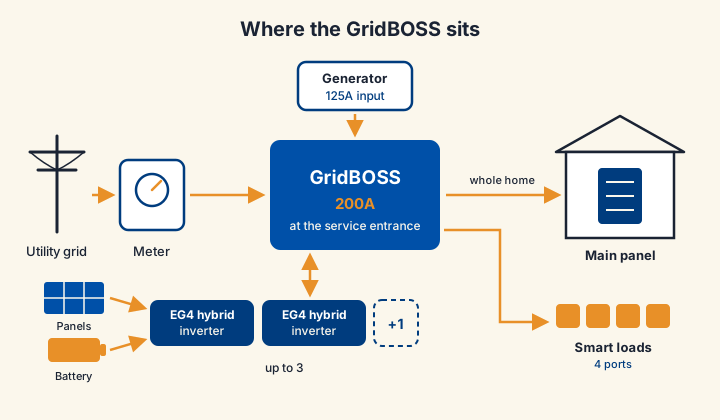
The GridBOSS is rated for a 200A residential service and can serve as the service entrance equipment alongside your utility meter, so the whole panel sits behind it. Backup covers everything you own. How long everything runs comes down to how much battery and inverter you put behind it, which is a sizing conversation, and a much better one to have than "which circuits made the cut five years ago."
What is on the box
Three hybrid ports take up to three EG4 hybrid inverters: the 12kPV, 18kPV, FlexBOSS18, or FlexBOSS21. This is an EG4 family device. The spec sheet is blunt that third-party inverters cannot connect to those ports.
There is a dedicated generator input rated to 125A. In a long stretch of cloudy outage days, a generator feeds the house through the same box instead of through its own separate transfer gear.
Four smart load ports handle the big appliances you would rather manage than babysit. Per the spec sheet, the box can shed those circuits when the battery runs low and bring them back when it recovers, and it can also run them only when the batteries are full and the sun is producing. Think pool pump or water heater: loads you are happy to feed with surplus solar and happy to drop at 2 AM on battery.
The cabinet is NEMA 3R rated, so it lives outdoors by the meter, and the unit carries UL1741, UL67, and UL869A listings.
When you actually need one
Two builds call for a GridBOSS.
The first is whole-home backup. If the goal is a house where an outage is a notification on your phone instead of an event, the GridBOSS is the piece that makes the whole panel, and everything on it, ride through. It is exactly why the box rides in our Whole-Home Backup kit.
The second is a battery-ready net metering build. Plenty of customers want the array and the bill savings now and the batteries later, once the budget recovers. Putting the GridBOSS in on day one means the transfer gear is already at the meter. When battery day comes, the batteries bolt onto the existing inverter and the system picks up backup duty with no rework at the service entrance and no new inverter.
When you can skip it
A shed, barn, or well system does not need one. A small building running on something like a 6000XP has no whole-home transfer to manage.
A true off-grid build does not need one either, and this surprises people. No grid means no interconnection. The GridBOSS's entire job is managing a grid connection, and if you do not have one, there is nothing for it to do.
And an honest critical-loads setup can skip it too. If what you really want protected is the fridge, the freezer, and some lights, a small backup system with a critical-loads subpanel costs less, and we will tell you so. Buying whole-home transfer gear to back up four circuits is oversizing, and we do not sell oversizing.
What Ape Solar would check first
Your service size comes first. The GridBOSS is built around a standard 200A residential service. If your home has something bigger or unusual, that is a design conversation before it is a quote.
Your inverter comes second. The hybrid ports are EG4-only, so a GridBOSS build means an EG4 hybrid inverter. If you already own a different brand, the transfer approach changes, and we would rather figure that out before you buy a box that cannot talk to your gear.
Then the honest question: what do you actually want to stay on? Whole home and critical loads are different budgets. Run the estimate with your real bill and we will size from there instead of guessing.
The safety note
The GridBOSS lands at your meter, and that connection is a licensed electrician's work. In the Florida panhandle, Ape Solar designs the system and runs the project, and a state-licensed contractor makes the service connection and pulls the permit. Interconnection also takes your utility's approval, and your local inspector, the AHJ, has the final say on the design. Inspectors tend to like clean, listed transfer equipment, but they get the last word, every time. Nothing in this guide is install guidance. It is a map of what the box does, so the quote makes sense.
FAQ
Does the GridBOSS work with inverters that are not EG4?
No. The hybrid ports support the EG4 12kPV, 18kPV, FlexBOSS18, and FlexBOSS21, and EG4's spec sheet says third-party inverters cannot connect to them.
Can I start with a GridBOSS now and add batteries later?
Yes, and that is one of the main reasons to buy it early. The transfer gear is already at the meter, so batteries bolt on later with no new inverter and no rework at the service entrance.
Do I need one if I am fully off-grid?
No. With no utility connection there is nothing to interconnect, so the box has no job. Off-grid builds handle backup by nature.
Does it handle a generator?
Yes. There is a dedicated generator input rated to 125A, so in a long outage a generator feeds the house through the same box.
How fast is the switchover when the grid fails?
About 25 milliseconds, per EG4's spec sheet. Most electronics in the house never register the gap.
What is the warranty?
EG4 backs the GridBOSS with a 10-year standard warranty.
Wondering what whole-home backup costs with your array and your battery count? Build a system and see the real numbers.