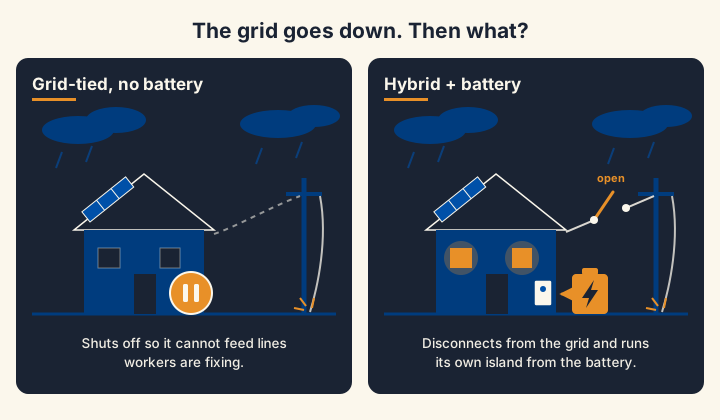
Here is the part that surprises people. A standard grid-tied solar array, the kind with no battery, shuts itself off the moment the grid goes down. The hurricane passes, the sun comes out, the neighborhood is dark, and your panels sit there in full sun making nothing. A battery and a hybrid inverter are what turn a solar house into the house with the lights on.
That is the whole answer in three sentences. The rest of this guide is why it works that way, and what a battery bank can actually carry once you have one.
Why your panels go quiet
When the grid drops, a grid-tied inverter is required to stop sending power out. The reason is people. Somewhere down the line a utility crew is fixing the break, and the wires in their hands have to be dead. If every solar house on the street kept pushing power in, those wires would stay live. So the inverter senses the outage and shuts the system down until the grid comes back. The equipment is listed and tested to do exactly this, and it is the right call.
The frustrating side effect is a sunny roof over a dark house. Nothing is broken. The panels just have nowhere safe to send the power, so the system waits.
What a battery changes
A hybrid inverter with a battery handles an outage differently. It disconnects your house from the grid, so nothing can flow out to those downed lines, and then it keeps running your backed-up circuits from the battery. Your house becomes its own small island. The panels keep working too. During the day they recharge the battery and carry the loads, and the battery covers the night.
One honest weather note. During the storm itself, heavy cloud cover cuts solar production way down, so the battery does most of the work while the rain is falling. The recharge really earns its keep in the days after, when the sun is back but the grid is still down. That is the stretch where a solar and battery house pulls ahead of a garage full of gas cans.
What a battery bank realistically carries
Every appliance in your house has a nameplate label with its draw on it, and your label beats any table on the internet, including this one. But typical ranges tell you the shape of the problem.
| Load | Typical running draw | Battery-friendly? |
|---|---|---|
| Fridge or freezer | 100W to 200W, cycling | Yes, easily |
| LED lights | A few watts per bulb | Yes |
| Ceiling fans | 30W to 75W each | Yes |
| Internet modem and router | 10W to 30W | Yes |
| Phones and laptops | Small | Yes |
| Window unit or mini-split | Hundreds of watts to a couple kW | Usually, with sizing |
| Well pump | Often 1kW or more, with a big starting surge | Doable, needs planning |
| Central AC | Roughly 3kW to 5kW while running | Hard on a modest bank |
| Electric water heater, range, dryer | Several kW each | Usually left off backup |
The pattern jumps out. The stuff that keeps a family comfortable and connected (cold food, light, moving air, internet) draws very little. Rough arithmetic makes the point: if those loads average around 400W together, a 12kWh battery carries them for a day and change on its own, before the panels add anything back. The stuff that heats water, dries clothes, and cools the whole house draws kilowatts, and that is where battery banks get big and budgets get real.
Central AC deserves its own sentence because it is the first thing every Florida homeowner asks about. Running it from a battery is possible. It takes a larger inverter and a lot more battery than a fridge-and-lights setup, and the battery drains fast while it runs. Many people split the difference with a mini-split cooling one room, which sips power by comparison.
Critical loads or the whole house
This is the fork in the road for your build, and it is a budget question as much as a technical one.
A critical-loads setup backs up a short list of circuits: the fridge, some lights and fans, the internet, maybe a window unit and the garage door. Smaller battery, smaller inverter, lower cost. The trade is that during an outage, the rest of the house stays dark. Our critical-load backup kit is built around this idea.
Whole-home backup carries everything, including the big appliances, which means more inverter capacity and a bigger battery bank. It costs more and it removes the "which outlet is live" question entirely. That is the whole-home backup kit territory.
Neither answer is wrong. A family that mostly wants the freezer full and the fans turning through a three-day outage does not need to pay for whole-home. A family that works from home or keeps medical equipment running may decide whole-home is exactly what the money is for. Run your own numbers in the system builder and see what each path actually costs before you commit to either story.
Good fit, bad fit
A battery backup system is a good fit if you live where the grid drops a few times a year, you want the fridge, lights, and internet to ride through it without you touching anything, and you like that the fuel refills itself every morning.
It is a worse fit if your real expectation is central AC plus a hot shower plus laundry on a small battery. That combination needs serious capacity, and anyone who tells you a compact system does it all is selling you a disappointment. It may also be more than you need if your outages are rare and last an hour. Be honest about the outages you actually get.
What Ape Solar would check first
Before recommending anything, we look at three things. Your power bill, which shows how much energy your house really uses. Your keep-running list, the loads you genuinely want carried through an outage, because that list sizes the battery and the inverter. And your electrical setup, since a critical-loads design usually involves work at your main panel, which is a job for a licensed electrician, permitted through your local building department.
We design the system and run the project. A state-licensed contractor does the electrical work.
A note on safety
Anything that touches your main electrical panel or connects a system to your home's wiring is licensed-electrician work, inspected by your local authority. This guide explains concepts so you can plan and buy smart. It is a starting point for a conversation, never a set of instructions.
FAQ
Will my panels recharge the battery while the grid is down?
Yes, with a hybrid inverter that is the whole design. Production sags under storm clouds, so expect the battery to carry the storm day and the sun to do the refilling once it clears.
Does the switchover happen automatically?
Backup systems are designed to switch on their own when the grid drops. How fast depends on the equipment, and with many modern hybrid systems the lights barely blink.
Can I add a battery to the grid-tied array I already have?
Often, yes. It depends on the inverter you have now. Some systems accept a battery directly and others get a hybrid inverter added alongside. Send us what you have and we can tell you which situation you are in.
Do I still need a generator?
Not necessarily, and some people run both. A battery gives you instant, silent, fuel-free backup. A generator adds cheap capacity for long cloudy stretches. Plenty of storm-country homes pair a modest battery with a small generator and cover both cases.
What happens if the battery runs out at night?
The backed-up circuits go dark until the sun comes up and the panels recharge it. That is exactly why the keep-running list matters. A right-sized battery with modest loads gets through the night with room to spare.
Send us your power bill and what you want to keep running. We will size it from your real loads, and if the smaller setup covers you, we will say so.