Watts measure how fast electricity is moving. Kilowatt-hours measure how much of it you used. One is a speedometer, the other is an odometer, and once you keep them straight, most of solar sizing turns into arithmetic you can do on a napkin.
Your power bill, your inverter, and your battery each use one of these numbers, and they are telling you different things. Here is how to read all three.
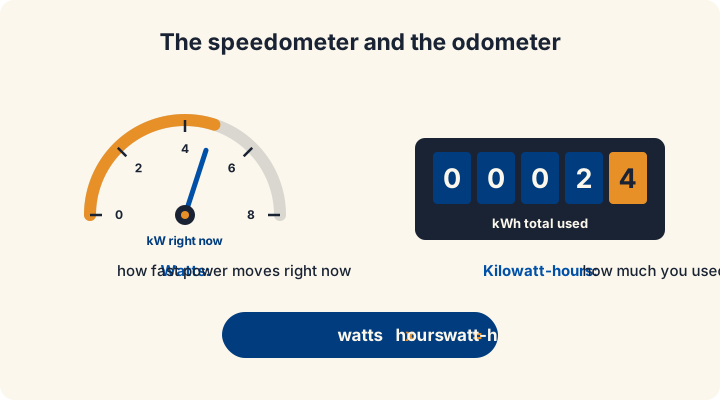
Speed and distance
Picture your car. The speedometer says 60 miles an hour. That is a rate, how fast you are moving right now. The odometer says you have covered 120 miles. That is a total. Drive at 60 for two hours and the odometer picks up 120 miles. Rate times time equals total.
Electricity works the same way. A watt is the speed. When a lamp is on, power is flowing through it at some rate, and watts are how we name that rate. A kilowatt is 1,000 watts, the same way a kilometer is 1,000 meters. A 400W panel and a 5kW air conditioner are both being described by their speed, one making power, one using it.
A kilowatt-hour is the distance. Run something at 1kW for one hour and you have used 1kWh. That is the odometer clicking over. The thing itself might be big or small. A tiny load running all day can rack up more kWh than a huge load that runs for a minute.
The one multiplication that matters
Watts times hours equals watt-hours. Divide by 1,000 and you have kilowatt-hours. That is the whole formula, and it works in both directions, for what your house burns and for what your panels make.
Take a fridge. A typical fridge draws somewhere between 100W and 250W while the compressor is running, and the compressor cycles on and off all day. Add up the actual run time and a typical fridge lands around 1kWh to 2kWh per day. Small speed, long hours.
Now central AC. A typical central unit pulls 3kW to 5kW while it runs. Say a 4kW unit runs a combined six hours across a hot July day. 4kW times 6 hours is 24kWh, from one appliance, in one day. Big speed, real hours. This is why summer bills sting.
A well pump sits in between. Typical running draw is 750W to 1,500W, but it only runs in short bursts while the pressure tank refills. An hour of total run time in a day is roughly 1kWh to 1.5kWh. The pump matters less for your monthly total and more for a different reason we will get to below: the jolt it takes to start.
The math works for production too. A 400W panel in an hour of strong sun makes about 400Wh. Give it five good sun hours and you get about 2kWh out of that one panel. Clouds, heat, and roof angle all shave the number, so treat it as a ceiling, and the shape of the math holds.
Why the bill, the inverter, and the battery all use different units
Your power bill is in kWh because the utility charges you for the total, the odometer reading. They do not care whether you used it fast or slow, only how much crossed the meter. It is the same reason a water bill charges by the gallon and never mentions how hard your faucet was running.
An inverter is rated in kW because its job is a rate. The rating is a ceiling on how much can run through it at the same moment. A 6kW inverter can carry up to 6kW of house at once. Ask it for more, at the same instant, and it trips or shuts down. It does not matter how much energy sits in the battery behind it; the inverter is the width of the pipe.
A battery is rated in kWh because it is a tank. A 10kWh battery holds 10kWh, full stop. How long that lasts is your draw doing the division. Sip at 500W and the tank runs about 20 hours. Pull 5kW and you get about two. Same battery, wildly different runtimes, and the only variable is the speed of the draw.
What this means for your build
You are sizing two separate numbers, and they do not substitute for each other. The kW number covers your biggest moment. The kWh number covers your longest stretch.
The biggest moment is everything you need running at the same time. Add up those watts and your inverter has to clear the total. One catch: motors surge when they start. A well pump or an AC compressor can pull several times its running draw for a second or two on startup, so the real peak is taller than the nameplate math suggests.
The longest stretch is a different sum. Add up the kWh per day of everything you want to keep alive, and that is what your battery bank has to hold, plus a margin for cloudy weather if the sun is doing the refilling.
Get these backwards and the system disappoints in a way no spec sheet warned you about. A big battery behind a small inverter runs the small stuff for days and still cannot start the AC. A big inverter on a small battery starts everything and quits before midnight. And oversizing both is its own mistake; capacity you never touch is money parked on a wall. The system builder does this addition against real equipment and real prices, which beats napkin math once you are past the concept stage.
What Ape Solar would check first
Before we talk equipment with anyone, we ask for a real power bill, twelve months of them if you have them, because that is your true kWh story with the seasons in it. Then we ask which loads actually matter to you in an outage, and which of those have motors, since a single well pump can set the inverter size for the whole build. Last, we ask what the goal is. Cutting the bill is mostly a kWh problem. Riding out a storm is both numbers at once.
FAQ
Is a 6kW solar system the same as 6kWh?
No. 6kW describes the array's rate in full sun, the speedometer. Over a full day that array might produce somewhere around 20kWh to 30kWh depending on the season and the weather. The kW is what it can do at its best moment. The kWh is what it actually delivered by sundown.
What will a 10kWh battery actually run?
Depends entirely on the draw. A fridge, some lights, and a couple of fans might total 400W to 600W, and 10kWh carries that for most of a day. Turn on a 4kW central AC and the same battery is done in a couple of hours. The tank never changes size. The speed you drain it does.
Why does a battery list both a kW number and a kWh number?
Tank size and spout size. The kWh is how much it stores. The kW is the fastest it can deliver. You need enough kWh to last the night and enough kW to start the well pump, and one does not cover for the other.
How many kWh does a house use in a day?
Many homes land between 20kWh and 40kWh a day, and a Gulf Coast summer with the AC working can push past the top of that range. Your own bill beats any rule of thumb: take the month's kWh and divide by 30.
Do more panels give me more kW or more kWh?
Both. Each panel adds to the array's kW rating, and a bigger array makes more kWh every day the sun cooperates. What panels never add is storage. If the power has nowhere to go when you are not using it, that is a battery conversation.
Once the speedometer and the odometer are separate things in your head, sizing stops being mysterious. Ready to put your own numbers in? Build a system and see the real numbers.