Critical-loads backup keeps a short list of circuits you picked ahead of time running through an outage, on one battery and a modest array. Whole-home backup puts transfer gear at your meter so the entire house rides through on a much bigger bank. Whole-home feels better. Critical loads usually costs a lot less, and for many homes it is the sharper buy.
The 9pm test
The power goes out at 9pm on a July night. In one version of your house, the fridge hums along, the wifi stays up, a few lights burn, and the window unit keeps the bedroom cool. The rest of the house sits dark until the line crew fixes the feeder. In the other version, nothing changes. You find out the grid is down when a neighbor texts you.
Both versions are real systems we sell. The difference is where the backup power gets handed to the house, and how much battery you buy to feed it.
What a critical-loads setup is
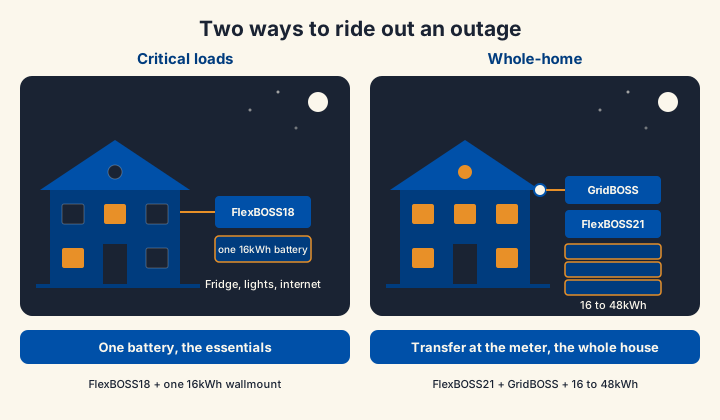
A critical-loads setup adds a second, smaller electrical panel next to your main one. It holds only the circuits you decided matter: the fridge, some lights, the internet gear, maybe a well pump or a window unit. Your electrician moves those chosen circuits into the new subpanel, and the inverter feeds that subpanel. When the grid drops, everything in it keeps running on battery and sun. Everything still in the main panel waits for the grid to come back.
Our Critical Load Backup kit is built exactly this way: an EG4 FlexBOSS18 hybrid inverter, one 16kWh indoor wallmount battery, and an array of roughly 3.1kW to keep that battery fed. On battery alone the FlexBOSS18 puts out 10kW continuous, which is more than a short list of essentials will ever ask for.
One detail on who supplies what. The subpanel itself and its breakers come from the installing electrician, because they have to match the brand of panel already in your house. The kit covers everything from the solar panels to the inverter.
What whole-home backup is
Whole-home backup skips the circuit picking. An EG4 GridBOSS, a 200A microgrid interconnect device, sits at your electrical service between the meter and the main panel, and your electrician makes that connection. When the grid drops, the GridBOSS transfers the entire house to the inverter and battery. Every outlet, every circuit, no second panel.
Our Whole-Home Backup kit pairs the GridBOSS with an EG4 FlexBOSS21 hybrid inverter, which puts out 12kW continuous on battery alone. The battery bank comes in three tiers, 16kWh, 32kWh, or 48kWh, which is one, two, or three of the same wallmount batteries. The 48kWh tier is the build our install customers order most. The batteries mount indoors, and you can add more later without a new inverter or controller.
Side by side
| Critical loads | Whole-home | |
|---|---|---|
| What stays on | The circuits you picked | The whole house |
| The transfer point | A subpanel next to your main panel | The GridBOSS at your meter |
| Inverter in our kit | FlexBOSS18, 10kW on battery | FlexBOSS21, 12kW on battery |
| Battery in our kit | One 16kWh wallmount | 16kWh, 32kWh, or 48kWh |
| Who supplies the panel gear | Subpanel and breakers from your electrician | GridBOSS ships in the kit |
| An outage feels like | Camping with the essentials handled | A normal evening, until you check the battery app |
What it means for your build
The battery is where the money lives, and the two approaches ask very different questions of it. A critical-loads bank only has to carry a fridge, some lights, and a small AC unit, so one 16kWh battery can stretch a long way. A whole-home bank has to carry whatever anyone in the house turns on, including the central AC and the water heater, so it starts bigger and grows from there. That is why the whole-home kit runs up to three batteries and the critical-loads kit runs one.
The array follows the same logic. A smaller backed-up load needs less solar to recharge the bank each day. More load, more battery, more panels. The exact counts and prices depend on your usage, so the system builder is where the real numbers live.
Here is the honest part. Whole-home backup is built so an outage changes nothing, and with enough battery behind it, it does. But the bank is still finite, and a house that runs like normal drains it like normal. Plenty of whole-home owners still walk over and shut off the big loads in a long outage. If you were going to manage your loads anyway, a critical-loads panel does that managing for you, permanently, for less gear.
Good fit, bad fit
Critical loads is a good fit when your worry is the fridge, the freezer, the well pump, and a livable room through a storm week. It fits a budget that has a ceiling. It also fits people who like knowing exactly what their backup can do, because the list of covered circuits is a list you wrote.
It is a bad fit if central AC through an August outage is the whole point, or if the house has loads that genuinely cannot drop, because a picked list means everything off the list goes dark.
Whole-home is a good fit for an all-electric house with people home all day, for anyone who wants zero outage behavior changes, and for homes where the battery budget can match the ambition. It is a bad fit when it is bought as a just-in-case flex for a house whose real need is a fridge and some lights. We see that one a lot. We talk people out of it.
What Ape Solar would check first
Before recommending either path, we look at three things. Your power bill, because real usage sets the battery and array math and guessing sets money on fire. Your must-run list, written down, because "the essentials" turns out to mean different things in different houses. And your service setup, including panel brand and where the meter sits, because that decides what the electrician needs to supply and how the transfer gear lands.
A note on the wiring
Both paths tie into your home's electrical service, and that work belongs to a licensed electrician under a permit from your local building department. The subpanel install and the GridBOSS connection at the meter are exactly that kind of work. Ape Solar designs the system and manages the project; a state-licensed contractor does the wiring. In the Florida panhandle, that is how our pro install runs every job.
Common questions
Which circuits usually end up in a critical-loads panel?
The fridge and freezer, a handful of lights, the internet equipment, and one comfort load like a window unit or fans. Rural homes add the well pump. The garage door opener is the one people forget until the first outage.
Can backup power run my central AC?
Central AC is usually the load that decides which path you need. It draws enough that carrying it points you toward the whole-home setup and a bigger bank, and even then it shortens your runtime more than anything else in the house. This is exactly the question we size from a real bill rather than a guess.
Can I start with critical loads and go whole-home later?
Yes, and the core gear carries over. The wallmount batteries and the array keep their jobs, and the step up adds the GridBOSS at the service plus whatever battery the bigger load needs. Starting small is a legitimate plan, and the battery bank in either kit expands later.
Does whole-home backup mean unlimited power?
No. The transfer covers every circuit, but the bank still holds what it holds. Sun recharges it each day, and a long stretch of storm cloud is still a stretch you manage. The size of the bank sets how much normal you get.
Why doesn't the critical-loads kit include the subpanel?
Because subpanels and breakers have to match the brand of the main panel already in your house, and we cannot know that from a warehouse. The installing electrician supplies both, matched to your panel, and the kit covers everything from the solar panels to the inverter.
Not sure which side you land on? Send us your power bill and what you want to keep running, or build a system and see the real numbers for both paths before you spend a dollar on either.