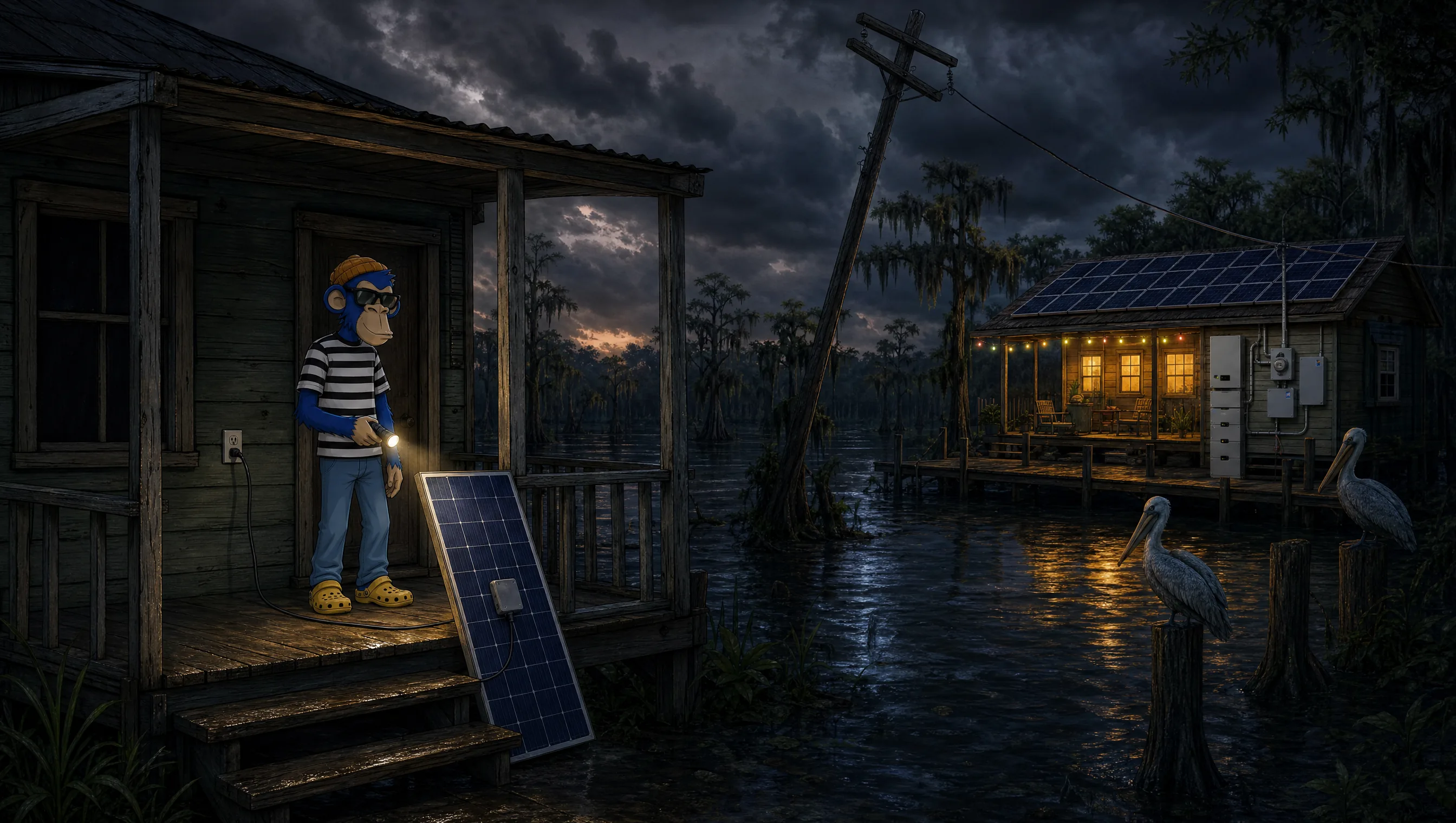
A panel leans on the porch rail. A cord runs from it to a regular wall outlet. The meter slows down. That's the pitch of plug-in solar, also called balcony solar: in the states that allow it, you plug it in yourself and skip the utility's sign-off. This year it went from a fringe idea to law in ten states, and people in the panhandle have started asking us about it.
The short answer for Florida is not yet. And if the reason you want one is the next hurricane, it won't help you anyway. The long answer lives in the little box between the panel and the plug.
The box doing the work
A solar panel makes DC power. Your outlets carry AC. The part in the middle of a plug-in kit is usually a microinverter, the same kind of part that sits under each panel on an Enphase roof. It takes the panel's DC and turns it into AC that follows the grid's, wave for wave, so the power can flow backward out of the outlet and into the house wiring.
That's what makes it different from a camping panel and a power station. A power station stores its own power and you plug things into it. A plug-in microinverter pushes power into a circuit your house is already using. Whatever the fridge on that circuit doesn't need goes on to the next load in the house, and anything the house doesn't use leaves through the meter.
It also means a plug-in microinverter can't run on its own. It follows the grid's AC, and when the utility drops, it shuts off. That's on purpose. Utah's law, the first one passed, requires a plug-in kit to have a feature that keeps it from powering the house during an outage. Without that shutoff, a kit could push power back up the house wiring and onto a line a lineman thinks is dead. (A battery system is different. Its inverter can build its own AC for the house when the grid is gone, which is the whole point of one. More on that below.)
Why electricians worry about it
Every circuit in your house has a breaker sized to protect its wire. That breaker only counts the current it sends out from the panel. Now plug a solar microinverter into an outlet near the start of a circuit and run a space heater and a hair dryer at the far end. Those loads pull their power through the last stretch of wire, part from the breaker and part from the solar. The breaker only counts its own part, so that stretch can carry more than the breaker is sized to protect, and the breaker never trips.
That's the core of the argument, and it's why the size caps are small. Most of the new laws stop at 1,200 watts (Colorado allows 1,920). In our catalog that's three 395W Canadian Solar panels. For scale, the Enphase array alone on Josh's house is 8.69kW.
It's also why the safety standard came late. UL Solutions started certifying plug-in systems in January 2026, under a standard called UL 3700 that covers overloads and power flowing the wrong way. Before that, plug-in kits fell outside the codes and standards the rest of solar gets tested against. The first plug-in microinverter sold in the US as meeting the new standard came out in July, and the trade press is already arguing over whether it's certified or only "designed to meet" it. Those are different claims. If you buy one where it's legal, look for the certification mark on the label itself.
Where it's legal
Utah went first, with a law that took effect May 7, 2025. California became the tenth state on September 30, 2026, and its rules start January 1, 2027. The details vary by state. Utah's is typical: up to 1,200 watts, a standard 120-volt outlet, a lab certification, no utility approval or fee, and no net metering credit for anything that goes out the meter. California's also stops at 1,200 watts and also skips the utility's approval.
Florida isn't on the list. There's no plug-in law, and there was no bill for one in the 2026 session. What Florida does have is the Public Service Commission's interconnection rule for the investor-owned utilities, and FPL serves much of the panhandle. Under that rule, a customer with solar tied to the grid signs the utility's standard interconnection agreement at least 30 days before turning it on, and the smallest tier covers everything from 10kW down. Co-ops and city utilities write their own agreements. Nobody in Florida has said yet whether a plug-in kit counts under any of them. That question is open.
Some people plug them in anyway. We'd rather show you how the rule reads than pretend it isn't there. If you're set on one, ask your utility before you plug it in.
The storm problem
Here's the part the kit sellers don't lead with, and down here it's the part that matters most. Go back to that microinverter shutting off when the grid drops. Since the last storm, we've taken calls from people with full rooftop systems and no battery who learned the hard way that their solar quits with the grid. A plug-in kit does the exact same thing, just smaller.
If what you want from the sun is lights and a cold fridge while the street is dark, the part you need is a battery and an inverter that can make its own AC with the grid gone. That system can start small. It can also be added to solar you already have, which we covered in keeping your Enphase or SolarEdge and adding batteries. If you're still weighing it against a generator, that's its own post.
What we'd tell a neighbor
If you rent, live in a condo, or just want to try a little solar, plug-in kits are a fair idea and the laws are spreading fast. Watch for Florida to take it up, and when it does, buy a kit with the certification printed right on the microinverter.
If you own your home in the panhandle and the goal is getting through a storm, put the money toward a battery system that runs when the grid doesn't. Tell the system builder what you want to keep running, and it will show you what that takes.
Ready for Anything.