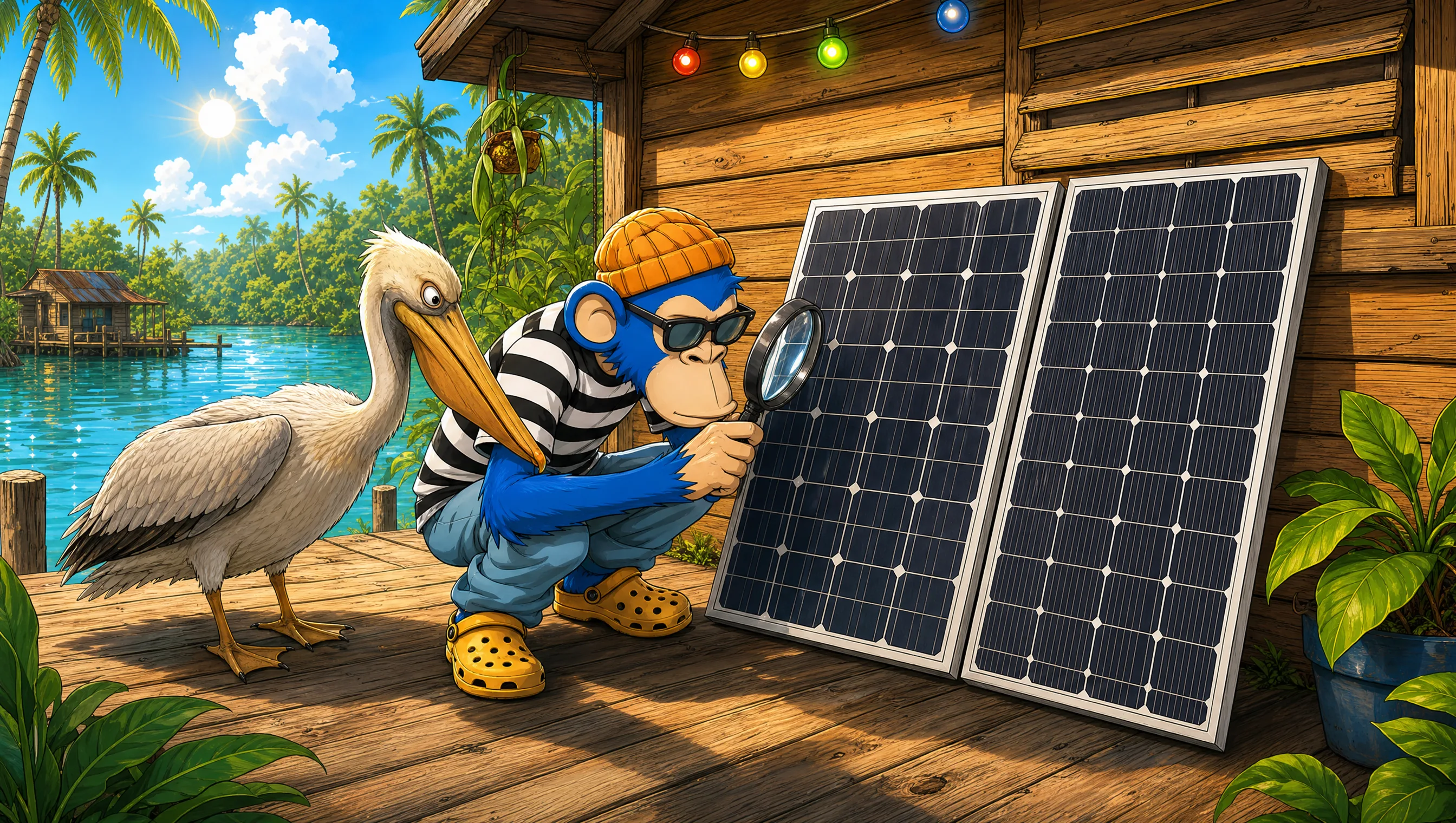
The listing says "$40 solar panels, barely used, must go this weekend." There's a photo of a pallet in somebody's driveway and a phone number. You do the quick math on twenty of them and your ground mount suddenly costs less than a riding mower.
Sometimes that math is real. Panels have no moving parts, and a well-made one keeps producing for decades. The panels coming off roofs right now are often coming off for reasons that have nothing to do with the panels: a reroof, an upgrade to bigger wattage, an insurance job where the whole array had to come down. We pull arrays like that ourselves, and plenty of what comes down works fine.
And sometimes the pallet is in that driveway because every panel on it spent ten years cooking on a roof in full Gulf humidity and half of them are quietly dead. The seller may not even know which kind of pallet he has. Your job is to know before your money leaves your pocket. It takes about five minutes per panel.
The eyeball test
Start with the glass. A cracked panel is a dead panel, even if it still reads voltage today. Water gets in, corrosion follows, and output falls off a cliff. Look at the glass at an angle in the light, because hairline cracks hide when you look straight on.
Then look at the cells through the glass. Brown or yellow discoloration across the cells means the laminate has been breaking down. Thin dark squiggles that look like slug tracks (installers literally call them snail trails) mean microcracks got in years ago. A milky, bubbled, or peeling look near the edges means the layers are separating, and the weather will finish that job for free.
Flip it over. The junction box on the back should be sealed shut, with no burn marks, no melted plastic, no smell. Wiggle the two cables: they should be firmly attached, with connectors that click and no cracked or sun-chalked insulation. Bent frames matter too. A corner that took a drop may have cracked cells you can't see, and a twisted frame fights the racking forever.
Any panel that fails the eyeball test stays on the pallet. There are no bargains behind cracked glass.
The meter test
Every panel has a label on the back with its rated open-circuit voltage. Carry a multimeter, put the panel in decent sun, and measure across the two leads. You're comparing what the label promises against what the panel does. A healthy panel in good light reads close to its rating. A panel reading far below it, or near zero, has a dead section or a failed diode, and no price fixes that.
This is thirty seconds per panel, and it's the single strongest filter you have. A seller who won't let you measure is answering your question a different way.
The math that decides it
Here's the part the listing never mentions. New panels are the cheapest they have ever been. That is a strange thing for a shop that sells them to lead with, but it changes what a used panel is worth. If a used panel with no warranty, unknown history, and a decade of wear costs almost as much per watt as a brand-new one with a 25-year warranty, the used panel isn't a deal. It's a gamble priced like a sure thing.
Space is the other half. Panel wattage has roughly doubled over the last decade, so an older panel makes half the power of a new one from the same patch of roof. On a house roof, where every square foot counts, that usually settles the argument in favor of new. On a ground mount behind the barn, where the constraint is dollars instead of square feet, old panels earn their keep.
One more trap: mixing. An array wants panels that match. Stringing mismatched wattages and vintages together drags every panel down toward the weakest one, and your inverter has opinions about the voltages it will accept. One consistent lot of twenty is worth more than a grab bag of thirty.
Where that leaves you
Used panels make the most sense where space is cheap and the budget is tight: ground mounts, sheds, barns, well pumps, off-grid projects that want watts more than warranties. For the roof over your kitchen, new panels at today's prices are usually the smarter buy, and we'll tell you that even when we have used stock sitting on the rack.
When good lots come through the shop we test and grade them before they go up for sale, and the ones that fail stay off the shelf. Check what's in stock at apesolar.com/shop/used. And if you're staring at a Marketplace pallet right now, message us the listing before you drive out there. We'll give you a straight read on whether it's the mower-money kind of deal or the ballast kind.