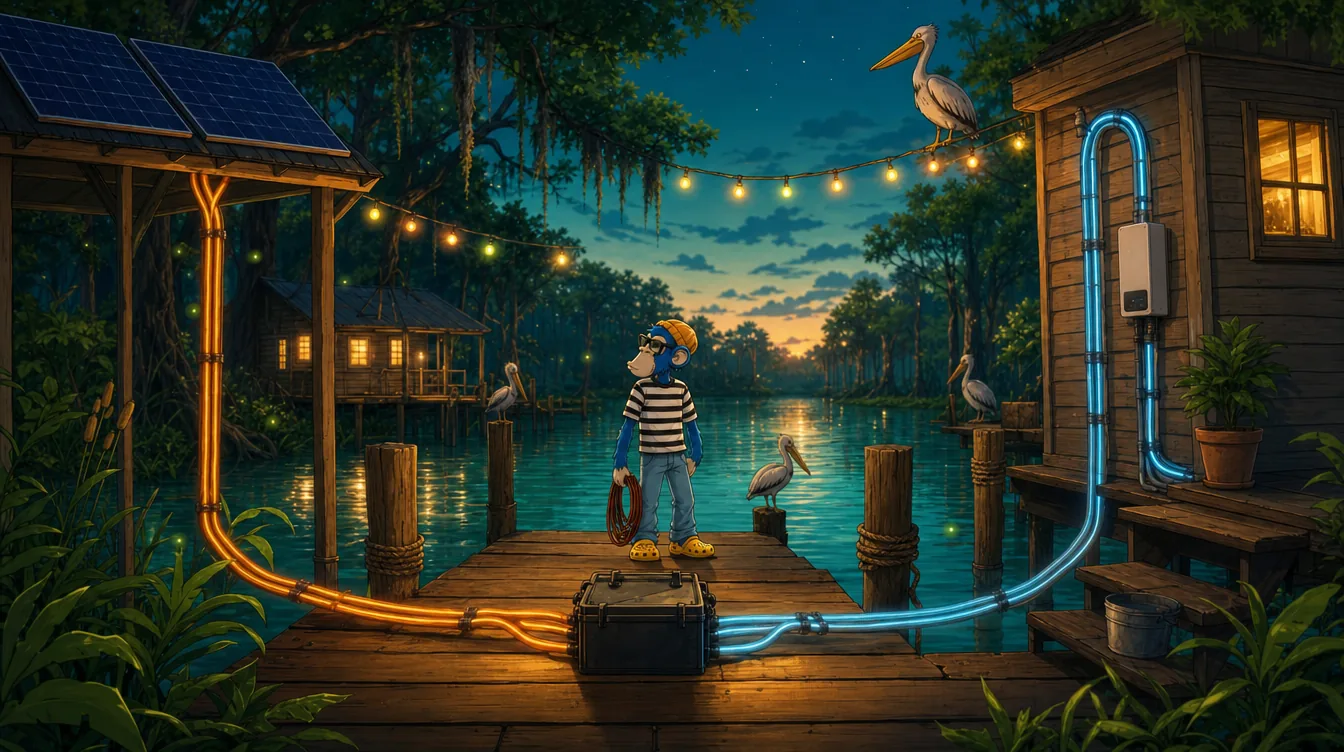
A customer called us with a roof full of microinverters and one question: do I have to tear all this out to add batteries? His system was six years old and working fine. Every quote he'd gotten started with "first we remove your existing equipment," and he didn't love paying to throw away gear that still made power every day.
He didn't have to. His system got AC coupled instead, and the old array never knew anything changed. Whether that's the right move for your house comes down to two words that get thrown around like everyone was born knowing them: AC coupling and DC coupling. Here is the plain version.
The one idea underneath both
Batteries store DC power. Panels make DC power. Your house runs on AC.
Every solar-plus-battery system has to move energy between those three, and the whole AC-versus-DC-coupling question is really just this: on its way to the battery, does the power from your panels stay DC the whole trip, or does it get converted to AC and back again?
That's it. That's the vocabulary.
DC coupling: the straight shot
In a DC-coupled system, the panels wire into a hybrid inverter, and that one box manages everything. Sunlight comes in as DC, charges the battery as DC, and only becomes AC at the moment your house actually needs it. One box, one conversion on the way out.
This is how we build every new battery system, because when you're starting from scratch there's no reason to do it any other way. The power takes the shortest path, so less of it is lost along the way. Every conversion between DC and AC costs you a slice of the energy as heat. A DC-coupled battery charges through fewer of those steps, and on a hot August afternoon with the array working hard, fewer steps means more of your sunlight ends up stored instead of warming up electronics.
There's a practical bonus too. One hybrid inverter is one thing to buy, one thing to wire, and one screen to check when something looks off.
AC coupling: working with what's already on the roof
Now go back to our caller. His panels each had a microinverter under them, which means his roof makes AC, panel by panel. That was the whole point of the system when he bought it. But a battery can't drink AC.
AC coupling adds a second inverter, a battery inverter, that catches AC power from the existing system and converts it back to DC to fill the battery. When the grid drops, that same box makes its own AC and keeps the house running, and the rooftop system keeps producing right alongside it.
The win is obvious: nothing on the roof gets touched. No re-permitting the array, no landfilling working microinverters, no scaffolding day. We've done exactly this, catching an existing Enphase array on the smart port of an EG4 GridBOSS, and the homeowner kept every watt the old system made.
The cost is the extra conversion. Panel DC becomes AC on the roof, becomes DC again in the battery, becomes AC again when you use it. Each hop shaves a little off. It still works, and it works well. It's just not the shortest road, so it gives up a few percent that the straight shot keeps.
So which one is yours?
If you're building new, DC couple it. One hybrid inverter, panels and battery both wired to it, done. This is the default for a reason, and it's what almost every current all-in-one system does.
If you already have a healthy grid-tie system and want backup, AC coupling is usually the honest answer. Ripping out working equipment to gain a few percent of charging efficiency almost never pays for itself. The exception is a system old enough that the inverters are near the end of their warranty anyway. At that point the teardown was coming regardless, and a fresh DC-coupled build can make sense.
And if a salesperson tells you your working system has to come out before you can have a battery, ask them why. There's sometimes a real reason. There's more often a reason that benefits the person quoting.
Not sure which side of the line your house is on? Send us a photo of your inverter or your panel setup and we'll tell you straight, even if the answer is "keep what you have." Start at apesolar.com/build or call the shop.
Ready for Anything.